Proposal: #
I have been spending a lot of time lately paying attention to my interactions with objects everyday: the moment my alarm goes off, my hand automatically searches for my phone, the tiny panic when a zipper jams or a Wi-fi router drops out. For my final project, I want to start from these moments, experimenting with rough prototyping before deciding the final direction. There are two directions of thought at the moment.
The first thread is about our strange, almost submissive truce with everyday objects. Think about the things sitting around a room right now: a table lamp, an alarm clock, a pair of glasses, a speaker, a vacuum cleaner, a calculator, an umbrella, a phone. Each one comes with it’s own rulebook. Follow the rules, and the object behaves; break them, and it’s chaos. Over time, we have trained ourselves to move around “their” demands rather than our own. I want to play around with this dynamic, and make our interactions more awkward, playful and surprising.
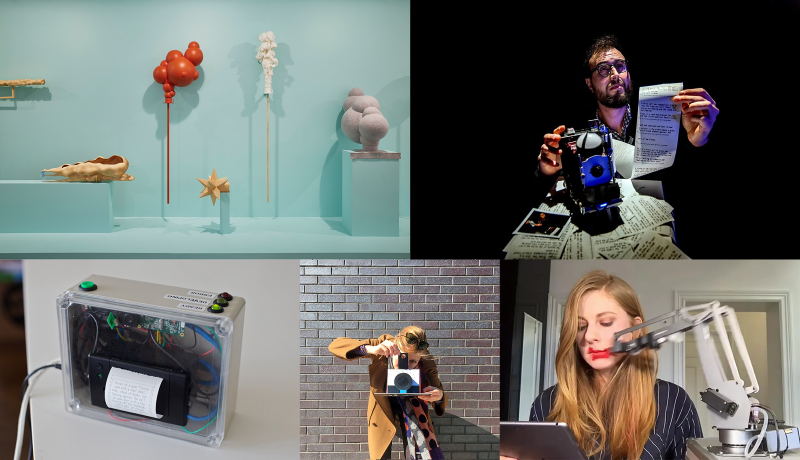
Right now, I have been mentally sketching a few different ways to do this: an alarm clock that refuses to stop ringing until you physically bow down to it; a wearable that makes your whole body light up every time a text arrives, or something that physically interrupts you when you get lost in an endless scroll; and a small handheld device you can point at any ordinary object: a mug, a radiator, a shoe; so it can recite a short poem about its own life.
For this direction, I keep coming back to artists who treat everyday objects with humor and suspicion: Anthony Dunne and Fiona Raby, whose critical design work twists familiar domestic objects until they reveal how they control us; Ross Goodwin, who built word.camera, a device that looks at the world and writes real-time poetry instead of taking photos; Matt Richardson, whose Descriptive Camera prints text descriptions on receipt paper rather than images; Kelli Anderson, who uses simple, tactile mechanics to expose how ordinary things actually work; and Simone Giertz, whose flawed machines poke fun at our obsession with obedient, efficient household tech.
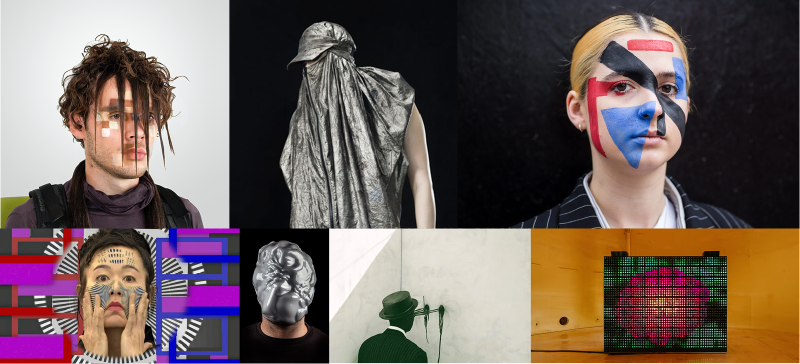
The second line of thought moves out of our houses and onto the street. Watching protests unfold around the world right now, it is impossible to ignore how much the rules of showing up in public have changed. Demonstrators are no longer just facing police lines; they are walking through nets of live facial recognition, drones and networked CCTV. Simply being visible in a crowd now carries a permanent trail. I have been fascinated by the grassroots tactics people use to push back, especially the anti-facial-recognition makeup protesters paint onto their faces, using sharp angles and asymmetric contrast to break the patterns computer vision algorithms look for. I want to see what happens when you bring physical computing into that space: building a wearable, a garment, or a portable object that senses when it is being watched and actively confuses, jams, or reflects the gaze of surveillance hardware.
I am quite inspired by artists working directly with visibility and refusal: Adam Harvey, whose CV Dazzle pioneered anti-facial-recognition makeup and hair styling, and whose Stealth Wear uses metallized fabric to hide from thermal cameras; The Dazzle Club, who stage silent walks through city streets in dazzle makeup to protest live police surveillance; Zach Blas, whose Facial Weaponization Suite turns aggregated biometric data into wearable, unreadable masks; Hito Steyerl, whose How Not to Be Seen looks at resolution, invisibility, and how to disappear from the frame; Trevor Paglen, who builds physical objects that make invisible surveillance networks tangible; and Simone Browne, whose book Dark Matters traces the long history of biometric tracking and the creative ways targeted communities subvert it.